

Why fitness empowers women: Science, benefits, and real strategies
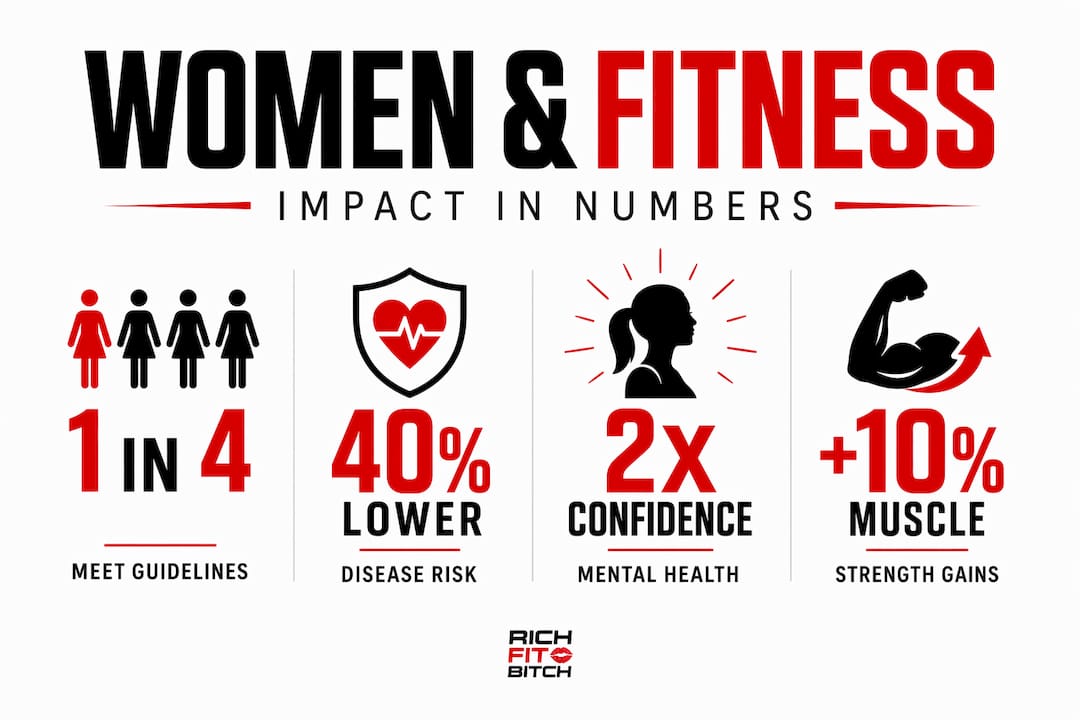
Only 1 in 4 women in the US aged 18 to 44 meets both aerobic and muscle-strengthening guidelines. One in four. Yet the conversation around women and fitness still gets hijacked by diet culture, “toning” myths, and the obsession with shrinking rather than building. Here’s the truth: fitness for women is not about fitting into a smaller size. It’s about building a body and mind that’s powerful, resilient, and unapologetically yours. This guide unpacks the real science behind why fitness matters so deeply for women, how your body uniquely responds to training, and exactly how to make it work for you at every stage of life.
Key Takeaways
| Point | Details |
|---|---|
| Holistic empowerment | Fitness for women drives strength, confidence, and resilience on both physical and psychological levels. |
| Science-backed health gains | Consistent strength and aerobic training protects bones, boosts longevity, and enhances well-being. |
| Unique female responses | Women adapt to fitness differently due to hormones but achieve similar relative gains as men. |
| Practical, age-aware routines | Blending strength, moderate cardio, and mindful nutrition optimizes fitness for women 25-45, especially during hormonal shifts. |
| Mindfulness beats perfection | True empowerment comes from flexible, supportive routines, not perfectionistic fitness standards. |
The unique value of fitness for women
Let’s be real for a second. The fitness industry has spent decades selling women a very narrow idea of what working out is for. Burn calories. Slim down. Get a flat stomach. But babe, that’s such a small slice of the actual picture.
Fitness delivers something so much richer. It builds confidence and psychological resilience in ways that nothing else quite replicates. When you deadlift more than you did last month, you don’t just feel stronger physically. You walk differently. You talk differently. You negotiate differently. That is main character energy, and it’s real.
“Fitness empowers women holistically by building strength, confidence, and psychological resilience. It’s not just a body transformation — it’s a life transformation.”
Women who exercise consistently report higher self-efficacy (that’s your belief in your own ability to handle challenges) and greater overall life satisfaction. That translates to better performance at work, better relationships, and a far healthier relationship with yourself. Your fitness motivation workflow matters as much as the workout itself.
Here’s where the barriers sneak in, though. Cultural pressure to look a certain way creates a perfection-driven standard that makes a lot of women either over-exercise in punishing ways or avoid fitness altogether out of fear of failing to measure up. Neither is the vibe we’re going for.
Real holistic fitness is built on these pillars:
- Strength that serves your daily life and long-term health
- Mental clarity that comes from consistent movement and endorphins
- Self-appreciation that grows every time you show up for yourself
- Stress resilience that makes you unshakeable when life gets chaotic
- Community that lifts you higher instead of comparing you down
Pair your movement with smart wellness nutrition insights and you have a foundation that literally transforms how you experience your life. The confidence building that comes from consistent fitness is documented, real, and available to every single one of us.
Key science-backed benefits of fitness for women
Okay queen, let’s get into the good stuff. The science here is legitimately exciting.
Resistance training provides women with a full spectrum of benefits including improved metabolic health, body composition, bone density, cardiovascular health, mental health, self-esteem, and body image. That’s not a claim. That’s peer-reviewed research. One workout modality, all of those outcomes.
“Strength training is not just about aesthetics. It’s your most powerful tool for longevity, mental wellness, and feeling like the absolute force of nature you are.”
And here’s a number that should make you want to book your next gym session immediately: women who strength train regularly two to three times per week have a 26% reduced risk of all-cause mortality. That means dying from anything, at any age. A quarter of a reduction in risk. Just from lifting weights consistently. That’s not a supplement, not a medication. That’s you, showing up for yourself.
Let’s break it down across key health categories:
| Benefit area | What fitness delivers for women |
|---|---|
| Bone health | Resistance training increases bone mineral density, reducing osteoporosis risk |
| Heart health | Regular aerobic and strength training lowers blood pressure and improves cholesterol |
| Metabolic health | Muscle mass increases resting metabolic rate, supporting healthy blood sugar regulation |
| Mental health | Exercise reduces symptoms of depression and anxiety as effectively as medication in many studies |
| Body composition | Strength training builds lean muscle, improving body composition without necessarily changing weight |
| Longevity | Consistent training correlates with significantly lower all-cause mortality risk |
| Self-esteem | Women who exercise consistently report stronger body appreciation and self-worth |
For practical, sustainable wellness guidance that ties all of this together, it’s worth exploring how to build routines that actually stick.
The mental health benefits deserve extra emphasis here. Exercise is one of the most evidence-supported interventions for anxiety and depression we have. And for women, who statistically experience higher rates of both, that matters enormously. Consistent movement isn’t self-care fluff. It’s medicine.

How women’s bodies respond: Physiology, hormones, and unique adaptations
Here’s where it gets really fascinating. And where a lot of myths get completely dismantled.
Women’s bodies respond to training through a complex interplay of estrogen, testosterone, growth hormone, and a process called mechanotransduction (basically how muscles sense mechanical stress and signal themselves to grow). The big revelation from recent research? Women achieve relative strength gains comparable to men, when adjusted for body size. So the idea that women can’t get strong because they have less testosterone? Outdated. Done. Finished.
Yes, women have less testosterone than men. But muscle adaptations in women are primarily driven by local mechanical signals at the muscle fiber level, not just by circulating hormones. Your muscles don’t care about the numbers on a hormone panel as much as they care about consistent, progressive overload.
Here’s a comparison that puts it in perspective:
| Training factor | Women | Men |
|---|---|---|
| Relative strength gains | Comparable when adjusted for body mass | High absolute gains |
| Muscle bulk potential | Limited without pharmacological support | Higher naturally |
| Recovery between sets | Often faster due to estrogen effects | Slightly slower recovery |
| Injury risk | Different patterns (ACL more common) | Different patterns (rotator cuff more common) |
| Hormonal influence on training | Cycle phase affects energy and recovery | More consistent hormonal environment |
Now let’s address the elephant in every gym locker room: “Will I get bulky?” No. You will not accidentally get bulky. Building significant muscle mass requires years of dedicated progressive overload, very high caloric intake, and in many cases hormonal advantages that most women simply don’t have naturally. What you will get is leaner, stronger, and infinitely more capable. That’s the glow-up.
Here’s how your body actually adapts when you start consistent training:
- Neural adaptations happen first (weeks 1 to 4): Your nervous system learns to recruit more muscle fibers efficiently. You get stronger before you even build noticeable muscle.
- Structural changes follow (weeks 4 to 12): Muscle fibers increase in size. Connective tissue strengthens. Bone density starts to improve.
- Metabolic shifts occur (months 3 to 6): Resting metabolism increases. Insulin sensitivity improves. Your body composition changes even if the scale doesn’t move dramatically.
- Hormonal regulation improves (ongoing): Regular exercise helps regulate cortisol, supports better sleep, and can positively impact estrogen metabolism over time.
Pro Tip: If you’re in your late 20s to early 40s, tracking your cycle and adjusting training intensity to align with your hormonal phases can meaningfully improve your energy, recovery, and results. Follicular phase? Go hard. Luteal phase? Dial back intensity and prioritize recovery.
Understanding your unique physiology is power. Pair that knowledge with the right fitness supplements for women and you’re genuinely building an unstoppable machine.
What type of fitness works best? Age, life stage, and practical guidelines
So you know the why. You know the how your body works. Now let’s talk about what to actually do, especially for women in the 25 to 45 range navigating real life, real schedules, and real hormonal shifts.
The ACSM recommends resistance training targeting all major muscle groups at least twice per week for healthy adults. That’s your non-negotiable baseline. Not five days a week of punishing boot camp. Twice a week of smart, progressive strength training is where the magic begins.
Here’s a practical framework for different life stages:
- Ages 25 to 35: Build your base. Focus on learning compound movements (squats, deadlifts, presses, rows). Incorporate two to three days of strength training and two days of cardio you actually enjoy. Prioritize consistency over intensity.
- Ages 35 to 40: Start paying closer attention to recovery. Sleep and nutrition become increasingly important. Add more mobility work. Consider tracking your cycle to optimize training phases.
- Ages 40 and beyond: This is where the rules change the most. Research shows that women over 40 should prioritize heavier lifting and polarized cardio due to hormonal and metabolic changes. Long, slow, steady-state cardio sessions can actually work against you during perimenopause by elevating cortisol. Shorter, more intense intervals plus consistent heavy lifting is your new formula.
📊 Statistic that matters: Women who start strength training after 40 can still achieve significant muscle growth and bone density improvements. It is never too late to start, and the metabolic benefits become even more critical as estrogen levels shift.
Pro Tip: If you’re new to lifting or returning after a break, start with two full-body strength sessions per week. Master the foundational movements before adding volume or frequency. Form first, weight second. Always.
The nutrition piece is inseparable from results. What you eat before and after training directly impacts muscle protein synthesis, energy levels, and recovery. Explore nutrition essentials for women to dial in the fuel side of the equation. If energy is an issue (and girl, for a lot of us it is), check out energy supplements for women that actually move the needle. And don’t sleep on recovery rituals. Wellness rituals for women like quality sleep, stress management, and mindful recovery are not extras. They’re core to the whole system working.
Why real empowerment through fitness looks different than you think
Here’s the take that the fitness industry doesn’t want to sell you, because it doesn’t come in a shiny package: the pursuit of a “perfect” body is often the thing standing between you and actual empowerment.
We’ve seen what happens when fitness gets tied exclusively to aesthetics. Anxiety spikes. Motivation crashes. Women cycle through phases of obsession and abandonment, never quite feeling like they’ve arrived. Research confirms that fitspiration content can actually foster body dissatisfaction and anxiety when it’s perfection-driven. The very thing marketed as empowering can quietly undermine it.
Real empowerment through fitness looks like this: you train because it makes you feel capable, not because you’re trying to punish yourself into a different shape. You appreciate what your body does more than what it looks like. You adapt your routine to your life season without spiraling when consistency breaks. You build fitness into your identity as a value, not an obligation.
The women we’ve seen truly transform through fitness are the ones who stopped chasing a specific aesthetic and started chasing strength, energy, and clarity. That shift changes everything. Suddenly the workout is a gift you give yourself, not a debt you’re paying off. The self-care nutrition tips align. The balanced transformation becomes sustainable.
Sustainable fitness is built on flexibility, self-compassion, and community, not on rigid rules and relentless comparison. A community of women lifting each other up (literally and figuratively) is the most powerful fitness tool in existence. That’s the Rich Fit Bitch ethos. That’s the whole vibe.
Empower your wellness journey: Next steps for you
You’ve got the science. You’ve got the strategy. Now it’s time to bring it all to life, babe. At Rich Fit Bitch, we’ve built an entire ecosystem to support your wellness journey from every angle. From curated supplements that actually work for women’s physiology, to elevated apparel that makes you feel like the queen you are the second you put it on, to nutrition guides designed for real women with real lives. This isn’t a one-size-fits-all prescription. It’s a fully personalized toolkit for women who are done playing small. Browse our collections, explore our wellness blog, and plug into a community that celebrates your power at every stage. Your strongest chapter? It starts right now.
Frequently asked questions
How much exercise do women really need for meaningful benefits?
The ACSM recommends at least two days per week of resistance training targeting all major muscle groups, combined with regular aerobic activity for broad health benefits. Even this minimum delivers significant metabolic, cardiovascular, and mental health improvements.
Is strength training safe for women, or will it make me ‘bulky’?
Strength training is completely safe and highly beneficial for women. Because women achieve relative strength gains through local muscle mechanisms rather than primarily through testosterone, the typical result is a leaner, stronger physique, not excessive bulk.
What type of exercise should women over 40 prioritize?
Women over 40 should focus on heavier strength training and shorter, more intense aerobic intervals rather than long steady-state cardio. Research shows that women in perimenopause benefit more from lifting heavy and doing polarized cardio to match their shifting hormonal and metabolic needs.
Why do so few women meet recommended fitness guidelines?
It comes down to a mix of time constraints, cultural messaging, lack of accessible support, and deeply rooted misconceptions about what exercise is appropriate or beneficial for women. Despite this, only 25.1% of women aged 18 to 44 meet both aerobic and muscle-strengthening guidelines.
Can fitness improve mental health and self-confidence in women?
Absolutely, and the evidence is solid. Fitness, especially strength training, builds confidence and psychological resilience while meaningfully improving self-esteem and body image. It’s one of the most powerful mental wellness tools available to women today.