

Why Choose Organic Supplements for Your Wellness Ritual
Not all supplements are created equal, babe. The market is flooded with synthetic, filler-packed capsules that promise everything and deliver basically nothing. If you are serious about why choose organic supplements, you already know your body deserves better than artificial dyes, mystery binders, and ingredients grown in chemically saturated soil. Organic supplements are not a trend. They are a refined, intentional upgrade to your wellness ritual — one that respects your body, your values, and the planet you walk on in stilettos. This guide breaks down what organic really means, what it does for you, and how to do it right.
Key Takeaways
| Point | Details |
|---|---|
| USDA Organic has real standards | Look for the seal that confirms at least 95% certified organic ingredients backed by federal enforcement. |
| Cleaner ingredients, less exposure | Organic supplements cut out artificial dyes, fillers, and synthetic pesticides that conventional options often carry. |
| Organic vs synthetic is nuanced | Bioavailability and absorption can differ, but third-party testing is non-negotiable for confirming true quality. |
| Match supplements to real needs | Target specific deficiencies first. Organic status matters most when paired with proven personal need. |
| Sustainability is personal power | Choosing organic aligns your wellness ritual with ecological values, reducing pollution and supporting biodiversity. |
Why choose organic supplements: what the label actually means
You have seen the USDA Organic seal plastered on everything from kale chips to collagen powder. But do you actually know what that seal is promising you? Let’s get specific.
The label is not decorative. Federal law defines three tiers:
- 100% Organic: Every single ingredient is certified organic. No exceptions, no wiggle room.
- Organic: At least 95% certified organic ingredients. This tier earns the USDA seal.
- Made with Organic: Contains 70 to 94% organic ingredients. Cannot display the USDA seal on the front of the package.
That distinction matters when you are spending real money on your ritual. A product sporting the USDA seal is not just marketing fluff. It has gone through certification, documentation, and annual inspections. The Organic System Plan (OSP) that every certified operation files details exactly how they prevent contamination and ensure traceability from farm to shelf.
Here is what most people miss: organic does not mean zero additives. It means fewer synthetics are allowed. The National List of approved and prohibited substances is reviewed every five years by the National Organic Standards Board, balancing strict ideals with practical farming realities. Certain synthetic substances are permitted only after rigorous review and consensus.
Pro Tip: When scanning a supplement label, look beyond the USDA seal. Check the ingredient list for the word “organic” before each key ingredient. If only two out of ten ingredients are organic, that product qualifies as “Made with Organic” — not as “Organic.” Do not let the green packaging fool you.
The real benefits of organic supplements for body and planet
Here is where it gets good. The benefits of organic supplements go beyond the feel-good factor of buying clean. There are tangible, studied reasons why upgrading your supplement ritual pays off in the long run.
Reduced chemical exposure. Conventional supplement ingredients are often sourced from crops treated with synthetic pesticides and fertilizers. Organic farming practices eliminate the majority of that load. Organic supplements avoid artificial dyes, fillers, and preservatives that health-conscious consumers are actively trying to avoid. Less junk in your capsule means less junk in your body. Period.

Potential nutrient quality differences. This is where nuance lives, queen. Organic farming does not guarantee a clinically superior product in every scenario. Processing and formulation can affect what actually reaches your cells. That said, ingredients grown in healthier, less chemically depleted soil tend to retain more of their natural integrity. Think of it like produce: a tomato grown in rich, organic soil just hits different than a greenhouse one pumped with synthetics.
Environmental impact you can actually feel proud of. Organic farming reduces nitrate leaching by 28% compared to conventional methods. Less chemical runoff means healthier waterways, more biodiversity, and soil that actually regenerates. When you opt for organic nutrition, you are not just feeding your body. You are voting for a healthier ecosystem with every purchase.
“Choosing organic supplements is a power move that honors your body and the planet simultaneously. That is main character energy right there.”
The advantages of organic vitamins and supplements also show up in your skin, your energy, and your overall glow-up. Fewer synthetic dyes and binders mean less inflammatory load on your system. Your liver is not spending overtime processing mystery ingredients. Your body gets cleaner raw material to work with. That clarity shows. And you can learn more about integrating these into your routine with intention.
Organic vs non-organic supplements: a real comparison
Let’s be real about the organic vs non-organic supplements debate. It is not black and white. But the evidence leans hard in one direction when you look at what actually ends up in your body.
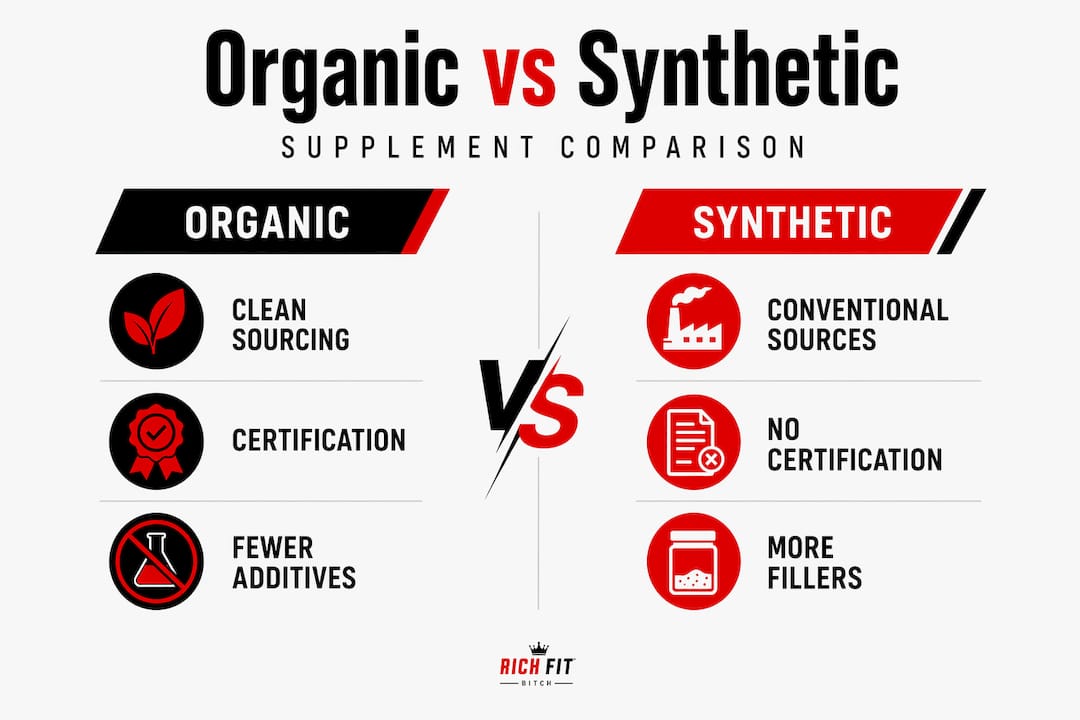
| Feature | Organic Supplements | Synthetic/Conventional Supplements |
|---|---|---|
| Ingredient sourcing | Certified organic farms, strict oversight | Conventional farms, synthetic inputs allowed |
| Synthetic pesticide residue | Minimal to none | Possible residue depending on sourcing |
| Artificial fillers and dyes | Not permitted under organic certification | Commonly used to cut costs |
| Bioavailability | Often more recognized by the body | Can vary widely; some synthetics absorb well |
| Third-party testing | Recommended additionally | Critical due to wider quality variance |
| Price point | 20 to 100% premium over conventional | Lower upfront cost |
| Environmental impact | Lower chemical load, better soil health | Higher pollution and runoff risk |
Now, about those label claims. FDA regulations require that structure/function claims on supplements do not need pre-approval but must be substantiated and cannot claim to treat or cure disease. That means a brand can say “supports immune function” without proving it first. Organic or not, you are not automatically protected from marketing hype.
This is exactly why third-party testing is your non-negotiable filter. Independent testing from organizations like US Pharmacopeia or ConsumerLab verifies purity and potency claims beyond what any label can tell you. The USDA seal tells you about the farming. Third-party testing tells you about the final product. You need both.
Pro Tip: Search for supplement brands that display both the USDA Organic seal and a third-party certification seal such as NSF International or USP Verified. That combo is the real luxury tier of supplement quality.
How to pick and use organic supplements like a pro
Knowing the advantages of organic vitamins is one thing. Building a ritual around them is another. Here is how to do it right without wasting money or falling for wellness theater.
-
Confirm your actual need first. Supplements work best when there is a proven deficiency or specific condition being addressed. Get bloodwork done. Know your numbers. Do not just grab a $60 adaptogen blend because it has a pretty label and #wellness vibes.
-
Verify the USDA seal authenticity. Look for the green and white seal on the front panel, then flip the bottle and check the ingredient list. Every key ingredient should have “organic” listed before its name. Audit your existing supplements right now.
-
Prioritize third-party verification. The USDA seal covers sourcing. An NSF or USP seal covers purity and potency. Look for both. Check out why supplement quality matters beyond just the organic claim.
-
Read labels for prohibited ingredients. Scan for synthetic dyes (Red 40, Blue 1), magnesium stearate in excess, titanium dioxide, and carrageenan. These are common in conventional supplements and have no business being in a refined wellness ritual.
-
Match dose to your specific biology. More is not more. Excess doses of nutrients like vitamin B6, vitamin A, and vitamin D can cause adverse effects. Organic does not cancel out the risk of overdoing it. Dose with intention.
-
Time your supplements strategically. Fat-soluble vitamins (A, D, E, K) absorb better with a meal containing healthy fats. B vitamins are best taken in the morning. Magnesium works beautifully at night. Pair your organic supplements with clean, whole-food nutrition for maximum effect.
Pro Tip: Avoid the trap of “expensive urine syndrome” — taking high-dose everything and absorbing a fraction of it. A targeted, moderate-dose organic supplement stack that fits your actual biology will always outperform a shopping cart full of mega-dose capsules.
Sustainable beauty and the eco-chic case for going organic
Choosing organic supplements is a lifestyle statement. It signals that you know what you are putting in your body, you give zero fucks about settling for less, and you understand that personal wellness and planetary health are not separate conversations.
Here is how your choice creates ripple effects:
- Pollution reduction. Organic farming practices limit synthetic chemical runoff into waterways, protecting aquatic ecosystems and the communities downstream.
- Biodiversity support. Without synthetic pesticides blanketing farmland, pollinators and soil microbiomes thrive. That ecological balance eventually feeds back into ingredient quality.
- Greenwashing defense. Brands with USDA Organic certification are held to documented standards. That transparency cuts through the noise of “natural” and “clean” claims that have zero legal definition.
- Sustainable sourcing signals abundance. When you invest in organically sourced products, you support farming systems built for longevity, not extraction. That is the abundance mindset in action.
- Alignment of values. Eco-friendly wellness is not a sacrifice. It is a refinement. Explore eco-friendly wellness habits that pair perfectly with an organic supplement ritual.
The reasons to choose organic go beyond your personal glow-up. They are about building a life where every choice reflects the queen you are.
My unfiltered take on organic supplements
I have spent years studying wellness trends, talking to experts, and filtering through the noise of the supplement industry. Here is what I know for certain: the average supplement aisle is a graveyard of mediocrity dressed up in glossy packaging.
I have seen gorgeous women drop real money on synthetic multivitamins loaded with artificial colors and ingredients their bodies cannot even recognize. The product looks luxe. The reality is anything but. That disconnect is what bothers me the most.
My experience tells me that organic status is one essential factor, not the whole story. You still need to know your deficiencies, verify third-party testing, and dose correctly. Organic without that foundation is just expensive marketing. But organic with that foundation? That is a bespoke wellness ritual that actually moves the needle.
The mindset shift I want you to make is this: stop treating supplements like an afterthought. They are part of your daily ritual, your declaration of self-worth, your investment in the woman you are becoming. Settling for synthetic, filler-packed garbage is the wellness equivalent of wearing knockoffs. You are worth the real thing. Manifest that.
— Patrice
Upgrade your ritual with Richfitbitch specialty supplements
You now know what to look for, what to avoid, and exactly why organic supplements belong in your daily ritual. Richfitbitch built the specialty supplements collection with all of this in mind. Every product is curated for quality, clean sourcing, and the kind of results that actually show. No filler. No synthetic nonsense. No compromises.
This is wellness that matches your ambition. Whether you are building your morning ritual, targeting specific goals, or just ready to stop settling for basic, Richfitbitch has the elevated essentials you deserve. Check out our holistic wellness supplement guide for empowered women to pair your new knowledge with the right products. Boss up, babe. Your ritual is waiting.
FAQ
What makes a supplement officially organic?
A supplement labeled “Organic” must contain at least 95% certified organic ingredients and must pass annual inspections under the USDA National Organic Program. The “100% Organic” designation requires every single ingredient to be certified organic.
Are organic supplements worth the higher price?
Organic supplements typically cost 20 to 100% more than conventional options, reflecting certification and sourcing costs. For consumers who prioritize reduced chemical exposure, cleaner ingredients, and environmental impact, that premium reflects real value.
Do organic supplements absorb better than synthetic ones?
Organic supplements may be more readily recognized by the body due to their natural sourcing, but bioavailability varies by product and formulation. Third-party testing from organizations like US Pharmacopeia is the most reliable way to confirm actual potency and purity.
Can you take too many organic supplements?
Yes. Excess doses of nutrients like vitamin D, vitamin A, and B6 can cause adverse effects regardless of whether the supplement is organic. Always target supplementation to confirmed deficiencies and follow recommended dosing.
What is the difference between “organic” and “natural” on a supplement label?
“Organic” is a federally regulated term with strict certification requirements. “Natural” has no legal definition in the supplement space and can be used freely by any brand. Always look for the USDA Organic seal rather than trusting “natural” claims.
Recommended
- How to choose supplements for women’s holistic wellness – RICH FIT BITCH
- Top wellness supplements for women: Boost holistic health – RICH FIT BITCH
- Discover 6 types of wellness rituals to empower your daily life – RICH FIT BITCH
- Transform Your Routine: Top Wellness Rituals for Women 2026 – RICH FIT BITCH