

Unlock wellness empowerment: A guide to holistic health
Wellness is not just a gym membership and a salad, babe. Most women are out here thinking they’ve cracked the code because they hit their step count and swapped fries for sweet potatoes. But real wellness? It goes so much deeper. Wellness empowerment is a multidimensional process that enables you to actively manage your holistic health, mind, body, spirit, and community included. It is about owning your agency, building self-belief, and creating a life that actually feels good from the inside out. This guide is your full breakdown of what wellness empowerment truly means, how to activate it, and why it is the glow-up you did not know you needed.
Key Takeaways
| Point | Details |
|---|---|
| Holistic empowerment | Wellness empowerment is about taking charge of all aspects of health—not just fitness or nutrition—by building self-efficacy and community support. |
| Evidence-backed benefits | Scientific studies show empowerment boosts confidence, reduces stress, and leads to better quality of life for women. |
| Personalized journeys | Success means starting with small, consistent habits and adapting tools to fit your lifestyle and needs. |
| Power of community | Connecting with others on the same journey amplifies results and makes empowerment sustainable. |
What is wellness empowerment?
Let’s get into it. Wellness empowerment is not a buzzword or a vision board aesthetic (though we love both). It is a real, research-backed process where you take an active role in every dimension of your health. Think of it as the upgrade from passive health consumer to the CEO of your own well-being.
Wellness empowerment is a multidimensional process built on self-efficacy, agency, and community. That means it is not just about what you eat or how often you move. It is about believing you can change, having the tools to do it, and surrounding yourself with people who lift you higher.
The core components include meaning, competence, self-determination, and impact. These are the psychological pillars that make empowerment stick. Without them, any wellness routine is just a trend you will drop by February.
Here is what those pillars actually look like in real life:
- Meaning: You understand why your health matters to you personally, not because a magazine told you to.
- Competence: You build skills and knowledge so you feel capable, not overwhelmed.
- Self-determination: You make choices that align with your values, not external pressure.
- Impact: You see and feel the results of your actions, which fuels you to keep going.
And here is the part most wellness content skips entirely: community matters enormously. You can explore wellness manifestation basics all day, but without real connection and support, progress stalls. Empowerment is not a solo sport.
“True empowerment is not a destination. It is an ongoing practice of choosing yourself, again and again, with the support of your people.”
For women aged 25 to 45, this is especially relevant. Life is full, careers are demanding, relationships need tending, and your own needs often end up last on the list. Wellness empowerment flips that script. It is the foundation for holistic lifestyle empowerment that makes every other area of your life feel more aligned and abundant.
Core pillars: Fitness, nutrition, and self-care in empowerment
Okay queen, now that you know what wellness empowerment actually is, let’s talk about how you build it daily. Because empowerment is not just a mindset shift. It is a series of small, intentional actions that compound over time into something extraordinary.
Holistic self-care practices like daily rituals, whole foods, joyful movement, stress management, and community support are the methodologies that make empowerment real. Not punishing workouts. Not restrictive diets. Joyful, sustainable, you-centered habits.
Here is a practical breakdown of empowerment rituals across the three core pillars:
| Pillar | Daily ritual | Why it works |
|---|---|---|
| Fitness | 30-minute walk, yoga, or dance | Builds consistency and body confidence |
| Nutrition | Prioritize protein, eat whole foods | Stabilizes energy and supports hormones |
| Self-care | Morning journaling, evening wind-down | Reduces cortisol, anchors mindset |
| Community | Weekly check-in with your wellness crew | Boosts accountability and belonging |
| Sleep | 7 to 9 hours, consistent schedule | Restores everything, non-negotiable |
The CDC recommends 150 minutes of moderate physical activity per week. That breaks down to about 22 minutes a day. Totally doable, right? The key is choosing movement you actually enjoy. Walking counts. Dancing in your kitchen counts. Pilates counts. Movement that feels like punishment? Hard pass.
Here is how to build your empowerment habit stack, one step at a time:
- Start with one habit. Pick the pillar that feels most neglected and commit to one small action daily.
- Track your wins. Celebrate every small victory. Confidence is built through evidence.
- Fuel your body right. Check out nutrition essentials for women to get your food game elevated.
- Set clear intentions. Use setting wellness goals as your roadmap, not a rigid rulebook.
- Build your support system. Community is a pillar, not a bonus.
The global wellness economy is massive, which means there is no shortage of tools and resources available to you. The trick is choosing what actually serves your balanced wellness empowerment journey.
Pro Tip: Start with just one new habit at a time. Stacking too much at once is the fastest way to burn out. Nail one, then layer the next. Small wins build the self-efficacy that makes everything else possible.
Benefits of wellness empowerment: Evidence and outcomes
Let’s talk results, because you deserve receipts. Wellness empowerment is not just feel-good theory. The data is real, and it is impressive.
Empowerment programs boost self-efficacy, quality of life, and reduce stress and anxiety in measurable ways. We are talking a self-efficacy score increase of 2.79 points and anxiety reductions of up to 13 points in structured programs. That is not a subtle shift. That is a life-changing one.
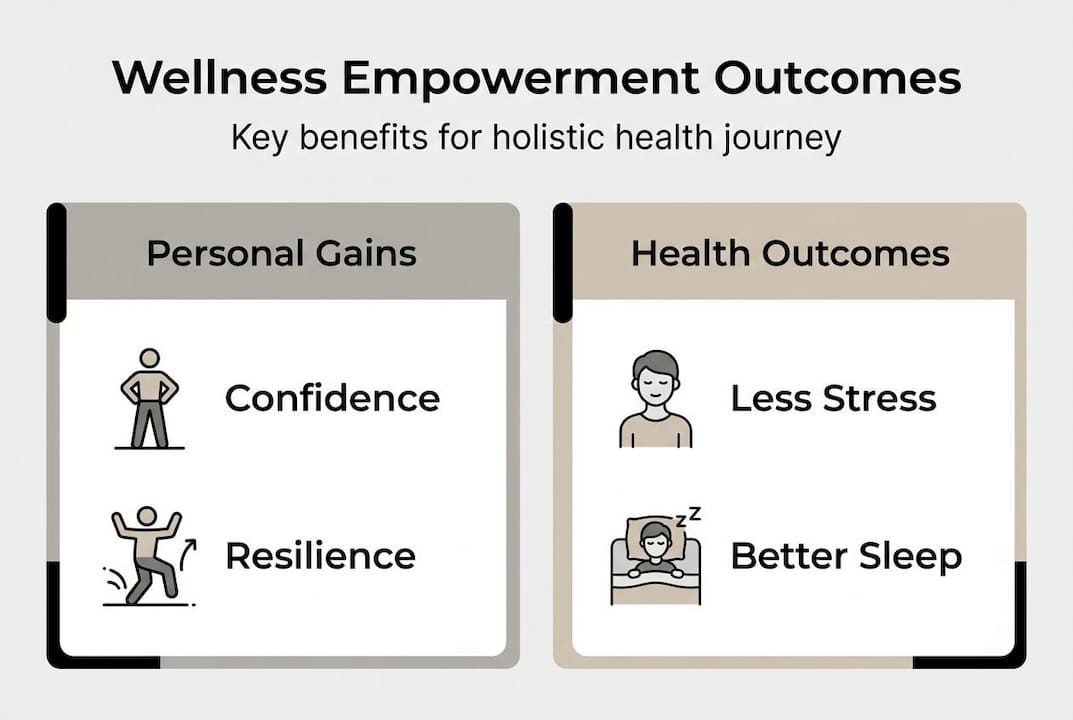
Here is a comparison of outcomes for women using empowerment frameworks versus those who are not:
| Metric | With empowerment framework | Without empowerment framework |
|---|---|---|
| Self-efficacy score | Significantly higher (+2.79) | Baseline or declining |
| Anxiety levels | Reduced by up to 13 points | Often unchanged or worsening |
| Quality of life | Measurably improved | Stagnant or inconsistent |
| Physical activity | More consistent and joyful | Sporadic, guilt-driven |
| Life satisfaction | Higher and sustained | Variable |
And it is not just for women who are already thriving. Empowerment improves activity levels, pain management, and fatigue even in women living with chronic conditions like rheumatoid arthritis. That is powerful proof that this approach meets you exactly where you are.
Here is what you can realistically expect when you commit to wellness empowerment:
- More confidence in your body and your choices
- Less fatigue and more sustained energy throughout the day
- Reduced anxiety and a calmer, more grounded mindset
- Greater life satisfaction and a sense of purpose
- Stronger immune resilience and better physical health markers
- Deeper connection to yourself and your community
Think about what long-term holistic wellness actually looks like when these benefits stack up over months and years. It is not just a healthier body. It is a whole upgraded life. And pairing your empowerment practice with the right supplements for empowering wellness can accelerate those results even further.
Beyond the individual: Community, challenges, and critiques
Here is where it gets real, babe. Wellness empowerment is powerful, but it is not a one-size-fits-all magic formula. And pretending it is would be doing you a disservice.
Younger women, high medication burden, and health fatalism are all factors that can lower empowerment outcomes. Age, cultural background, access to resources, and even the number of prescriptions you are managing can all affect how easily you step into your wellness power. That is not a personal failing. It is just reality, and it deserves acknowledgment.
Common obstacles and how to work around them:
- Time scarcity: Micro-habits (5 to 10 minutes) are just as valid as hour-long routines.
- Financial barriers: Free movement, community gardens, and online support groups are all real options.
- Cultural disconnects: Seek wellness spaces that reflect your background and values.
- Chronic illness or medication: Work with your care team to adapt practices safely.
- Mental health challenges: Start with the gentlest pillar, often self-care or community, before adding intensity.
Creating a supportive wellness space for empowerment at home can also make a massive difference when external barriers feel heavy.
“Wellness empowerment must go beyond individual willpower. Systemic, cultural, and communal factors shape health outcomes just as powerfully as personal choices.”
Individual empowerment models are critiqued for ignoring systemic needs, and that critique is valid. True empowerment does not place all the responsibility on your shoulders alone. It recognizes that community, culture, and access all play a role.
Pro Tip: Stop trying to do this alone. Find your people, whether that is an online community, a local wellness group, or a single accountability partner. Belonging is not optional. It is fuel.
Why the typical definition of wellness empowerment misses the mark
Most wellness content hands you a checklist and calls it empowerment. Drink water. Sleep 8 hours. Meditate. Done. But that approach misses the whole point, and honestly? It can make you feel worse when life gets messy and the checklist falls apart.
Real empowerment is not about perfection. It is about flexibility, self-compassion, and community rituals that hold you even when your willpower is at zero. The mainstream wellness space often ignores cultural nuance, financial reality, and the very human need to belong. It sells you the idea that if you just try harder, you will get there. But that framing breeds shame, not strength.
What we have seen work, truly and sustainably, is this: micro-habits paired with genuine connection. One small action, done consistently, supported by people who get it. That is the formula. Not the 5 AM routine. Not the $300 supplement stack. The 2026 wellness trends point toward exactly this shift: community-centered, culturally aware, and deeply personal wellness practices. Empowerment that actually sticks is built on grace, not grind.
Connect with tools and community to amplify your empowerment journey
Ready to take your empowerment journey further? You have got the knowledge. Now let’s talk action. At Rich Fit Bitch, we have curated everything you need to live this lifestyle fully and unapologetically. From nutrition for empowered women that actually supports your hormones, energy, and goals, to specialty supplements designed with your holistic health in mind, we have got your back. But more than products, we are a whole vibe and a whole community. Join the Rich Fit Bitch community and connect with women who are manifesting abundance, sharing energy, and giving zero fucks about anything less than their best life. Your empire is waiting, queen.
Frequently asked questions
How is wellness empowerment different from self-care?
Wellness empowerment is multidimensional, integrating self-efficacy, agency, and community, moving well beyond individual routines to foster true, lasting agency over your health. Self-care is one tool in the toolkit; empowerment is the whole strategy.
What are small, practical steps to begin wellness empowerment?
Start with one consistent habit like daily walks or prepping whole food meals, then build community support to boost motivation and sustain your results over time. Small, stacked wins are the foundation of everything.
Does wellness empowerment work for women with chronic illnesses or mental health challenges?
Empowerment programs improve outcomes for women facing chronic conditions and anxiety, including measurable gains in self-efficacy, stress reduction, and quality of life. It meets you where you are and grows with you.
Are there any downsides or critiques of wellness empowerment?
Individual empowerment models are criticized for overlooking systemic and cultural needs, so personalizing your approach and seeking community support is absolutely essential for real results.
Recommended
- Holistic wellness: Empowering women through balanced health – RICH FIT BITCH
- Your 2026 wellness trend guide: holistic well-being unlocked – RICH FIT BITCH
- Sustainable wellness guide: holistic health & lasting well-being – RICH FIT BITCH
- Wellness manifestation: empower your health in 2026 – RICH FIT BITCH